

Cirugía de pérdida de peso y depresión: Comprender el vínculo
La obesidad y la depresión suelen ir de la mano. Las personas que luchan contra la obesidad tienen un riesgo un 55% mayor de desarrollar depresión en comparación con la población general.[1] Aunque todavía se están estudiando las razones exactas de esta relación, las investigaciones sugieren que factores como la inflamación, la alteración de la función cerebral y el estigma social pueden desempeñar un papel.[2] Para muchos, la cirugía de pérdida de peso proporciona un tratamiento eficaz para la obesidad grave. Sin embargo, es importante ser consciente de que la cirugía puede afectar a la salud mental tanto de forma positiva como negativa.

Fortunately, weight loss surgery, including procedures such as the gastric sleeve, the gastric bypass, and the Lap-Band, offers more than just physical transformation. With proper care, patients often experience emotional healing alongside weight loss. That’s why we provide comprehensive support for both the body and mind at every stage of the journey.
Addressing Depression Before Bariatric Surgery
Individuals considering weight loss surgery should be screened for pre-existing mental health conditions like depression. Studies show that up to 50% of bariatric surgery candidates have a history of depression.[3] Untreated depression before surgery can negatively impact outcomes.
Candidates must receive appropriate treatment to manage depression before undergoing surgery. This may involve therapy and/or antidepressant medication. Getting depression under control beforehand allows patients to be in the best mindset to handle the challenges of surgery and make the lifestyle changes needed for success.
Every patient at Healthy Life Bariatrics undergoes a thorough psychological evaluation before surgery. This is not to disqualify anyone, but to ensure you are mentally and emotionally prepared.
We assess:
Existing depression or anxiety
Coping mechanisms
Lifestyle habits
Support system at home
If needed, we can connect you with licensed therapists or refer you to a bariatric support group for guidance.
How Bariatric Surgery Can Improve Mental Health?
Many patients ask whether weight loss surgery can improve depression. In our experience, the answer is often yes.
Procedures like the gastric sleeve and gastric bypass lead to:
Rapid weight loss
Increased energy
Improved self-confidence
Better mobility and lifestyle
As patients begin to feel healthier and more in control, mood and outlook often improve. At Healthy Life Bariatrics, we closely monitor each patient’s emotional wellbeing throughout the process—from the first consultation through the long-term follow-up phase.
Bariatric Procedures Offered at Healthy Life Bariatrics
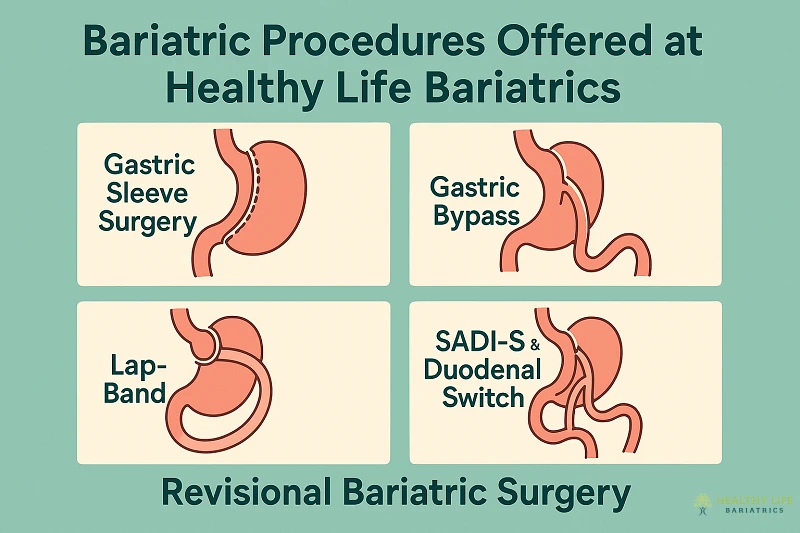
We specialise in a full range of weight loss surgery options, each customised to the patient’s needs and medical history:
Gastric Sleeve Surgery
A restrictive procedure that reduces the size of the stomach to help you feel full faster and consume fewer calories.
Gastric Bypass
Combines restriction and malabsorption by creating a small stomach pouch and rerouting a portion of the intestines, leading to significant weight loss.
Lap-Band Removal or Revision
For patients who have had limited success with the Lap-Band, we offer Lap-Band revision procedures, often converting to a gastric sleeve or bypass for better results.
SADI-S & Duodenal Switch
Advanced procedures for patients with high BMI or complex cases, offering powerful results with careful nutritional support.
Revisional Bariatric Surgery
If you’ve had a previous surgery that did not deliver expected outcomes, we provide expert revision surgery to improve weight loss and reduce complications.
Risk of Depressive Symptoms After Weight Loss Surgery
Riesgo de síntomas depresivos tras la cirugía
Aunque la cirugía de pérdida de peso puede influir positivamente en la autoestima y la calidad de vida de la mayoría de los pacientes, algunos pueden experimentar síntomas depresivos tras la intervención. Las tasas comunicadas varían mucho, desde el 5% hasta más del 50%[4]. Entre los factores potenciales se incluyen:
- Dificultad para afrontar un cambio rápido en la imagen corporal y los hábitos alimentarios
- Deficiencias nutricionales como hierro, folato y B12
- Cambios neuroquímicos debidos a la restricción calórica
- Expectativas insatisfechas respecto a la cantidad de peso perdido
- Lucha por mantener los cambios en el estilo de vida para mantener el peso
Todos los pacientes deben someterse a un cribado cuidadoso y a un seguimiento de la depresión durante los 1-2 primeros años tras la intervención quirúrgica[5] Cualquier síntoma emergente debe tratarse con prontitud mediante grupos de apoyo, terapia, medicación o asesoramiento nutricional, según sea necesario.
Nutritional Deficiencies and Mood
Some emotional symptoms after surgery may stem from nutritional imbalances. That’s why we routinely monitor vitamin and mineral levels.
For example:
Vitamin B12 and iron deficiencies can lead to fatigue and low mood
Vitamin D supports mood regulation and immune health
We customise each patient’s supplement regimen and ensure they receive ongoing lab testing to prevent or correct deficiencies.

Why Choose Healthy Life Bariatrics?
Led by Dr. Babak Moeinolmolki, Healthy Life Bariatrics offers:
✅ Comprehensive bariatric care – from consultation to long-term follow-up
✅ Expertise in all major procedures – including gastric sleeve, bypass, Lap-Band revision, and SADI-S
✅ Psychological support and screenings built into every care plan
✅ Access to support groups, therapy referrals, and nutrition experts
✅ State-of-the-art facilities in Los Angeles, serving Beverly Hills, Century City, and surrounding areas
We don’t just help patients lose weight. We help them reclaim their lives, physically and emotionally.
Schedule a Consultation : Begin Your Journey to Better Health in Los Angeles, CA

It's normal to experience emotional ups and downs before and after weight loss surgery. Having a strong support system is key - this can include friends, family, support groups, and mental health professionals. Patients should be proactive and speak up if they experience symptoms of depression at any point so appropriate treatment can begin right away.
With proper mental health care and self-care, most bariatric patients can successfully manage depression symptoms and experience significant improvements in emotional well-being. Please consider a consultation with Dr. Babak Moein to begin your personal journey.
Conseguir apoyo
Es normal experimentar altibajos emocionales antes y después de la cirugía de pérdida de peso. Es fundamental contar con un sistema de apoyo sólido, que puede incluir amigos, familiares, grupos de apoyo y profesionales de la salud mental. Los pacientes deben ser proactivos y hablar si experimentan síntomas de depresión en algún momento, para que pueda iniciarse inmediatamente el tratamiento adecuado. Con una atención de salud mental y unos cuidados personales adecuados, la mayoría de los pacientes bariátricos pueden controlar con éxito los síntomas de la depresión y experimentar mejoras significativas en su bienestar emocional. Considera una consulta con el Dr. Babak Moein para iniciar tu viaje personal. Referencias: [1] https://www.ncbi.nlm.nih.gov/pmc/articles/PMC4551126/ [2] https://www.ncbi.nlm.nih.gov/pmc/articles/PMC5669931/ [3] https://asmbs.org/resources/mental-health-and-weight-loss-surgery [4] https://www.ncbi.nlm.nih.gov/pmc/articles/PMC3996125/ [5] https://asmbs.org/resources/postoperative-depressive-symptoms-after-bariatric-surgery [6] https://jamanetwork.com/journals/jamasurgery/fullarticle/2774542